
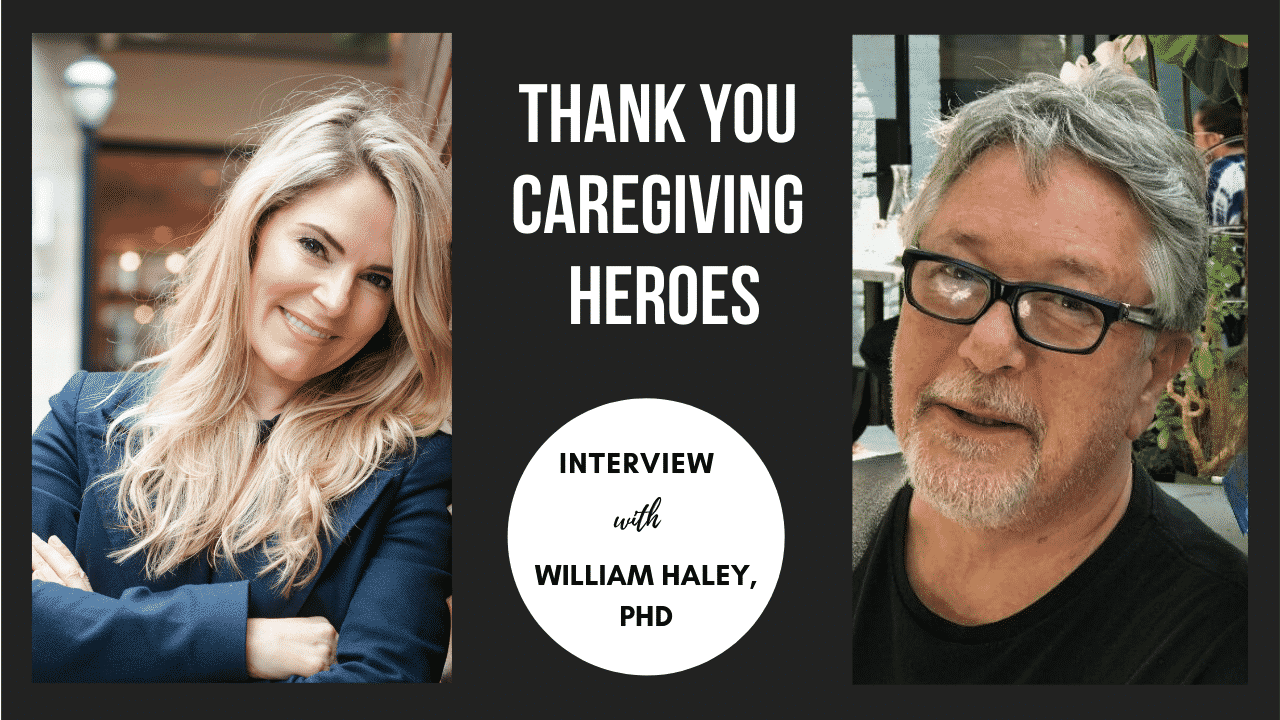
We have a narrative in society that says that caregivers have more depression and stress, spend their caregiving years suffering, only to lead to premature death. Our guest today shares a more balanced and factual narrative about caregivers.
Yes, many caregivers do indeed have increased rates of stress and depression. Research shows, however, that caregivers are remarkably resilient and actually DO NOT have a reduced lifespan as a result of caregiving.
Our guest today, Dr. William Haley, Professor of Aging Studies, reveals how caregiving actually affects caregivers and shares several resilience strategies you can use (starting today) to bolster your resilience and lower your stress. Listen until the end for all the great tips and strategies.
Here’s a peak inside my interview with Dr. William Haley:
- [04:02] Dr. Haley shares his story: Where he’s from and what inspired him to study aging and caregiving.
- [8:23] Learn about a stress and coping model tailored just for caregivers.
- [14:33] Caregivers are more physically and psychologically resilient than we give them credit for. Learn all about caregiver resilience here.
- [18:18] It used to be thought that the stresses of caregiving shortened our life span. But the reality is that caregivers who are stressed and depressed are actually living longer than non-caregivers who are stressed and depressed.
- [21:14] There are many benefits to finding meaning as a caregiver, one of the benefits being that it helps you cope with stress.
- [33:03] Dr. Haley summarized his recommendations of ways caregivers can bolster their resilience.
Want a quick tip? Click on this video clip for proven resilience strategies that you can start using today.
About Dr. William Haley
Dr. William Haley is a Professor in the School of Aging Studies at the University of South Florida. His research has focused on stress and coping in family caregivers of older adults with Alzheimer’s disease, stroke, cancer, and terminal illness. He has a special interest in caregiving and diversity, resilience to stress, and developing and evaluating interventions for caregivers. He has published over 170 peer reviewed research articles and serves on the Editorial Boards of several prominent journals in the field of aging. He has been President of the American Psychological Association’s (APA) Society of Clinical Geropsychology and Division of Adult Development and Aging, and was Chair of the APA Committee on Aging. Dr. Haley has also been honored as a Fellow by the American Association for the Advancement of Science, Gerontological Society of America, and APA. Dr. William Haley completed his PhD in Clinical Psychology, and a Postdoctoral Fellowship in Geriatric Clinical Psychology at the University of Washington-Seattle.
Links mentioned in this episode:

Dr. Regina Koepp is a board certified clinical psychologist, clinical geropsychologist, and founder and CEO of the Center for Mental Health & Aging: the “go to” place for mental health and aging. Dr. Koepp is a sought after speaker on the topics of mental health and aging, caregiving, ageism, resilience, intimacy in the context of life altering Illness, and dementia and sexual expression. Dr. Koepp is on a mission to ensure mental health and belonging for older adults, because every person at every age is worthy of healing, transformation, and love. Learn more about Dr. Regina Koepp here.
Regina Koepp, PsyD, ABPP













































Want More? Listen to Our Most Recent Episodes


Older adults deserve high quality mental health care.
Therapists deserve the training to provide that care.
